Why Your Garlic Bulbs Stay Small: 6 Common Mistakes (and How to Fix Them)

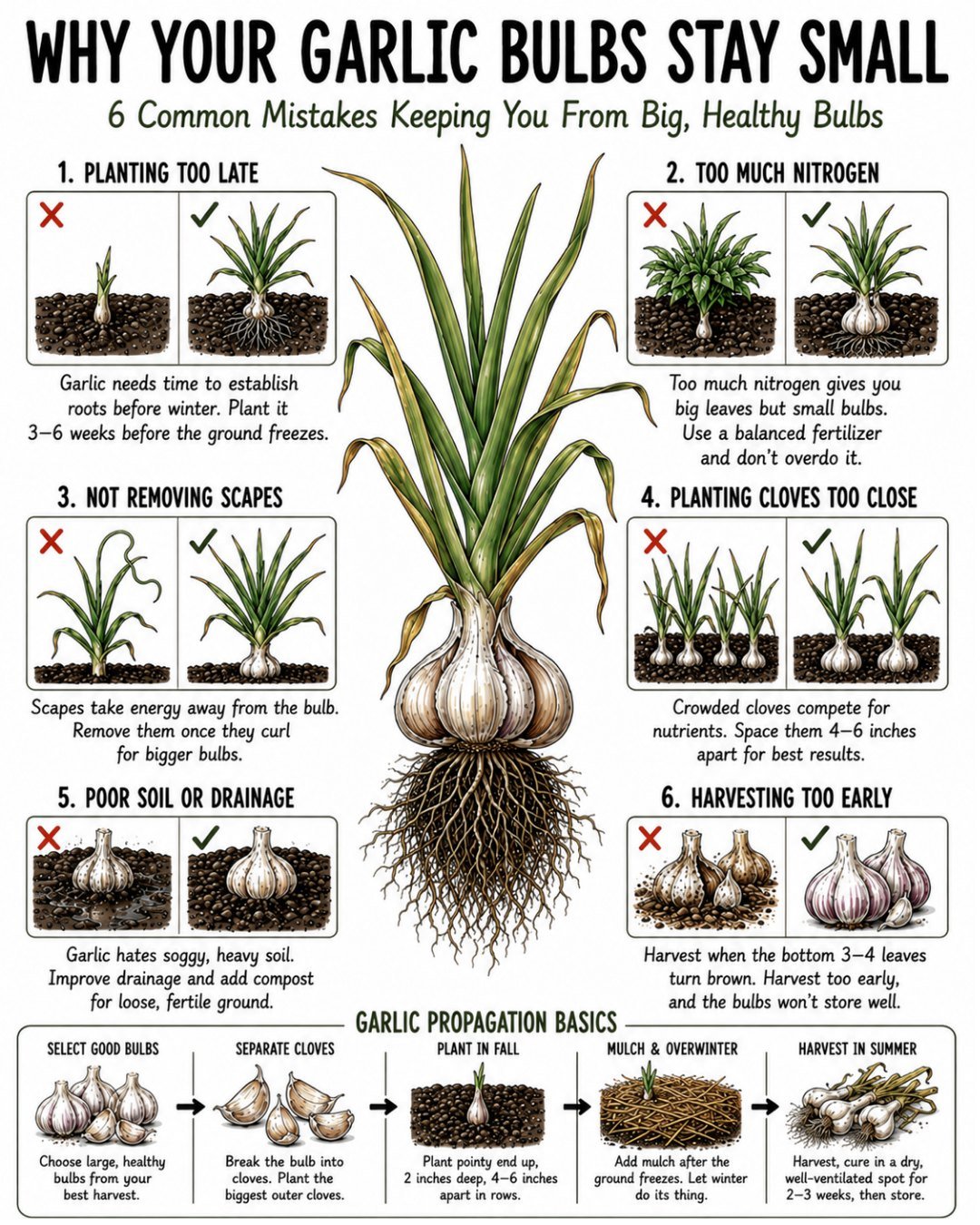
Quick answer: Small garlic bulbs almost always come down to six mistakes: planting too late (the cloves miss the winter chill they need), too much nitrogen (big leaves, tiny bulbs), leaving the scapes on hardneck garlic, planting the cloves too close, heavy or soggy soil, and harvesting at the wrong time. Fix those six, and your bulbs will get bigger.
Few things in the garden are as disappointing as waiting nine months for garlic and pulling up heads the size of a marble. I’ve grown garlic for years, and I’ve made most of these mistakes myself. The good news is that every one of them is easy to fix once you know what’s going on underground.
Mistake 1: Planting too late
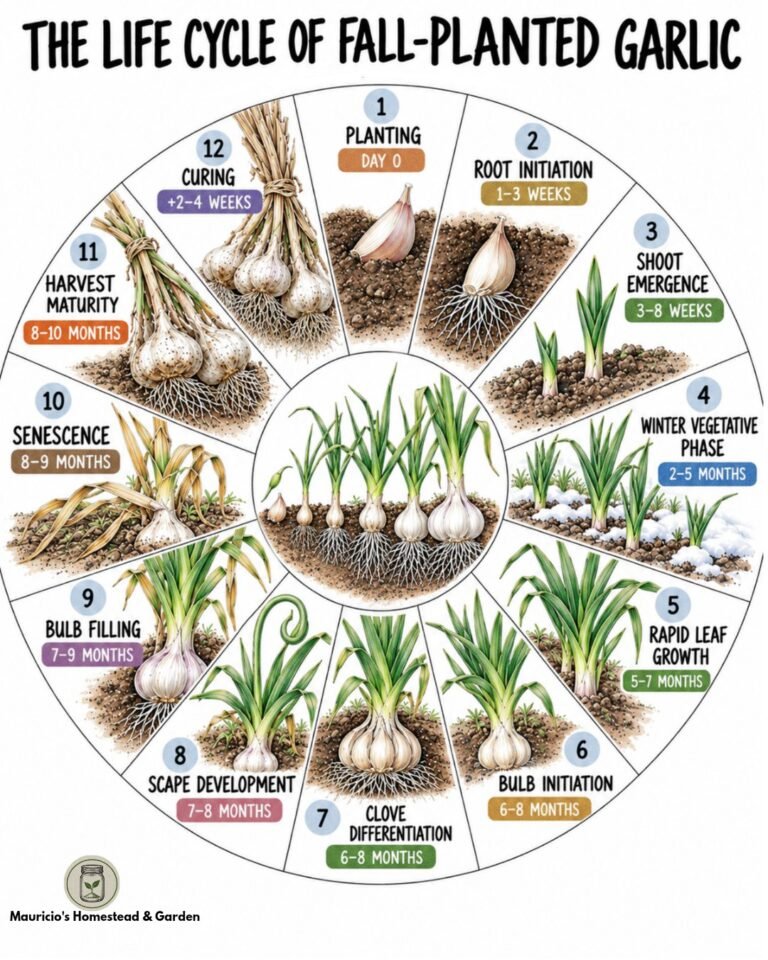
Garlic that goes in the ground too late just doesn’t develop well. The reason is cold. Garlic needs a period of chilling (called vernalization) to switch on bulb formation. Texas A&M AgriLife Extension explains that once garlic has been through that cold period, it starts forming bulbs when days get longer than about 13 hours and the soil warms past 60°F. Plant too late, and the cloves get less root time before winter and less of the chill they need, so you get smaller, poorly divided bulbs, or round, single-clove “rounds.”
The fix: plant in fall, a few weeks before your ground freezes. In most of the northern U.S. and Canada that means October. See my full guide on how to plant garlic in fall for timing by climate.
Mistake 2: Too much nitrogen
I feed my garlic with compost, bokashi, and manure from farm animals that I’ve already composted. But I learned this one the hard way: when I use a very high-nitrogen fertilizer like chicken manure without balancing it, the plants look amazing. They’re tall, thick, and dark green. Then you dig them up, and the heads are tiny, or there’s barely a bulb at all. It looks more like a leek than garlic.
Nitrogen drives leaf growth. Garlic does need it, but it needs a balance of nitrogen, phosphorus, and potassium, and it needs the nitrogen at the right time. The University of Maine Cooperative Extension recommends splitting nitrogen into spring applications instead of loading it all up front, and warns against applying nitrogen after early June because it pushes top growth at the expense of the bulb.
The fix: build your bed with well-made compost, use strong manures like chicken manure only after they’re fully composted and in moderation, feed in early spring when the plants are growing fast, and stop feeding once the bulbs start to form.
Mistake 3: Not removing the scapes
Hardneck garlic sends up a curly flower stalk in late spring called a scape. Cutting them off is one of my favorite garden jobs, and I always do it. I can see the difference between plants that get this attention and plants that don’t. Plus, I love scapes sautéed, or thrown into a pan of stewed tomatoes.
The research backs it up. In a 2020 trial across many garlic varieties, Seeds of Diversity Canada found that bulbs from plants with their scapes removed were on average 23% heavier, though results varied by variety. One warning: cut only the scape. University of Guelph research, published by the Government of Ontario, found that accidentally cutting even one leaf during scape removal reduced bulb size by about 13%.
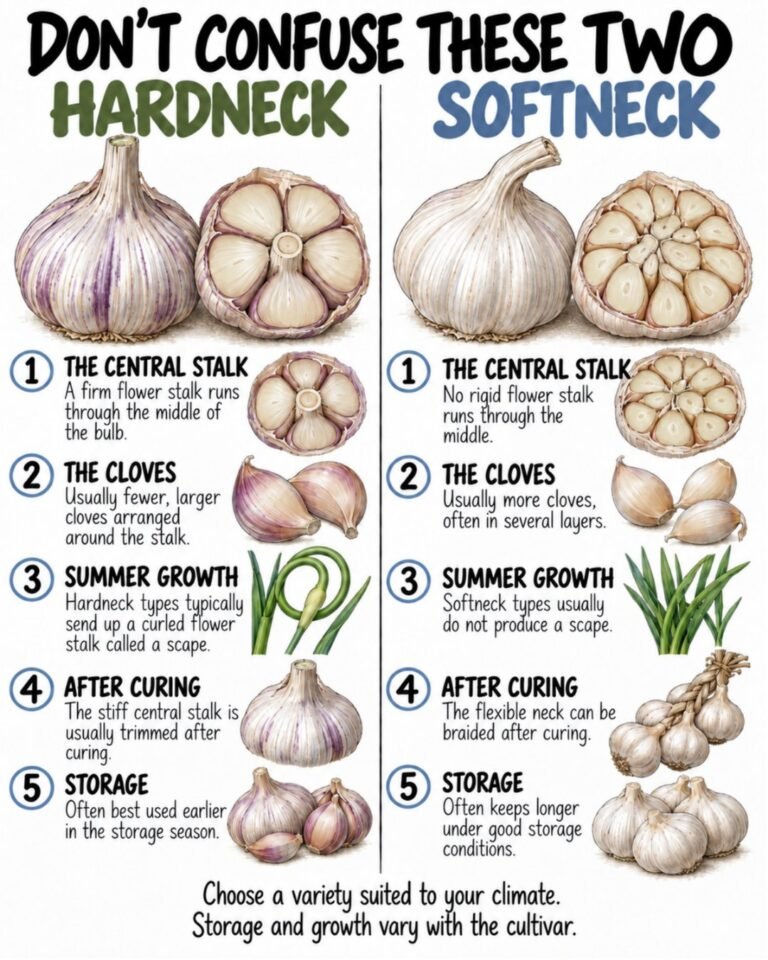
The fix: snap or cut the scape just above the top leaf once it starts to curl. Softneck garlic usually doesn’t make scapes, so there’s nothing to remove. Not sure which kind you have? See hardneck vs. softneck garlic.
Mistake 4: Planting the cloves too close
This one fools almost everyone. When you’re planting, the cloves are small, and the gap between them looks like plenty. Your eyes trick you. Then in spring the leaves and stems fill out, and you realize the plants are crowded together, competing for water, nutrients, and light. Crowded plants also stay damp, which invites fungal disease.
My trick is simple: I cut a little stick about 7 to 9 inches long and use it to measure as I plant. Every clove gets the same space, never too tight, never too wide. That’s a little wider than the 4 to 6 inches many guides suggest, and it’s on purpose. The University of Minnesota Extension notes that closer spacing gives you more but smaller heads, while wider spacing gives you fewer but bigger heads.
The fix: measure, don’t guess. Give each clove at least 4 to 6 inches, and more if you want bigger heads.
Mistake 5: Heavy or poorly drained soil
Heavy soil that holds water is bad for garlic. Honestly, it’s bad for almost any crop. Garlic sits in the ground all winter and spring, and cloves sitting in cold, wet soil rot, while compacted soil keeps the bulb from expanding.
For me, the soil has to be loose at least a foot deep (about 30 cm). Garlic grows a big mass of roots, and they need loose ground to spread out and find water and nutrients.
The fix: loosen the bed about a foot deep before planting, mix in plenty of compost, and if your native soil is heavy clay, plant in a raised bed. In heavy soil, also plant a little shallower.
Mistake 6: Harvesting at the wrong time
Harvest too early, and the bulbs haven’t finished sizing up, the cloves aren’t fully formed, and they won’t store well. Harvest too late, and the outer wrappers start to rot away, the bulbs split open, and they won’t store either. UConn Extension notes that once the bottom three leaves have browned, you have roughly a two-week window to get your garlic out of the ground before storage quality drops.
The standard sign is when the lower leaves are brown but about half the leaves are still green. I like to confirm it by gently uncovering the base of a few plants and looking at the heads. If they’re full and well formed, it’s time. You can also pull one and cut it in half: if the cloves fill the skins, the crop is ready.
The fix: watch the leaves and check a few bulbs before you dig the whole bed. Then cure the garlic in a dry, shady, airy place for 2 to 4 weeks.
Bonus mistake: thinking garlic is bulletproof
For a long time I thought garlic could handle anything. It can’t. Fungal leaf diseases like rust and leaf blight hit garlic often, especially in wet springs and crowded beds, and sick leaves mean smaller bulbs. Good spacing, good drainage, clean planting stock, and crop rotation prevent most of the trouble. I cover this in more detail in my garlic planting guide.
Small garlic FAQ
Why did my garlic grow as one round bulb with no cloves?
Those are called “rounds.” They usually happen when garlic doesn’t get enough cold, when it’s planted too late or in spring, when the cloves were very small, or when a variety isn’t suited to your climate. You can replant a round in fall, and it will usually divide into a normal head the next year.
Does the size of the clove matter?
Yes. Big cloves make big bulbs. Plant the large outer cloves and eat the small inner ones.
Can I fix small garlic this season?
Partly. In spring you can still weed, water during dry spells, remove scapes, and avoid late nitrogen. But timing, spacing, and soil are decided on planting day, so most of the improvement comes from planting better next fall.
Sources
- Texas A&M AgriLife Extension: Garlic
- University of Maine Cooperative Extension: Garlic IPM Newsletter (split nitrogen)
- University of Maine Cooperative Extension: Garlic IPM Newsletter (nitrogen timing)
- Seeds of Diversity Canada: 2020 Garlic Scape Experiment
- Government of Ontario: The Benefits of Removing the Garlic Scape
- University of Minnesota Extension: Growing Garlic
- UConn Extension: Garlic Cultivation in Connecticut
- University of Nebraska–Lincoln Extension: Growing Garlic