American Persimmon: How to Identify, Harvest, and Eat Wild Persimmons

Quick answer: The American persimmon (Diospyros virginiana) is a native wild fruit of the eastern and central United States. It is only good to eat when it is fully soft, wrinkled, and usually dropped from the tree on its own. Look for a combination of deep orange color and a very soft texture, because color alone can fool you. Peak harvest usually comes after the first frost, but the frost itself is not what ripens the fruit. Eat the pulp fresh, bake it into persimmon pudding, or freeze it. Don’t eat the seeds or the cap.
The American persimmon is one of those fruits most people walk right past. The tree grows wild along field edges, fence lines, and roadsides across a big part of the country, and every fall it drops hundreds of small orange fruits that nobody picks up except the deer, raccoons, and opossums.
I’ve eaten plenty of wild persimmons. I’ll be honest with you: it’s a good fruit, but it isn’t my favorite native fruit (that title goes to the pawpaw). What makes the persimmon worth knowing is how much free food one tree gives you, and how easy it is to get it wrong the first time. Here’s how to find the tree, how to tell when the fruit is actually ripe, and what to do with it.
What is the American persimmon?
The American persimmon, also called common persimmon or “possumwood,” is a native tree in the ebony family. It grows from southern Connecticut and Long Island down to Florida, and west through the lower Midwest into Oklahoma and Texas. The fruit is small, about 1 to 2 inches across, which is much smaller than the Fuyu and Hachiya persimmons you see at the grocery store. Those are Asian persimmons, a different species (Diospyros kaki).
One key difference for a forager: every wild American persimmon is astringent until it is fully ripe. Some Asian varieties, like Fuyu, can be eaten firm and crisp like an apple. A wild American persimmon never can.
How to identify an American persimmon tree
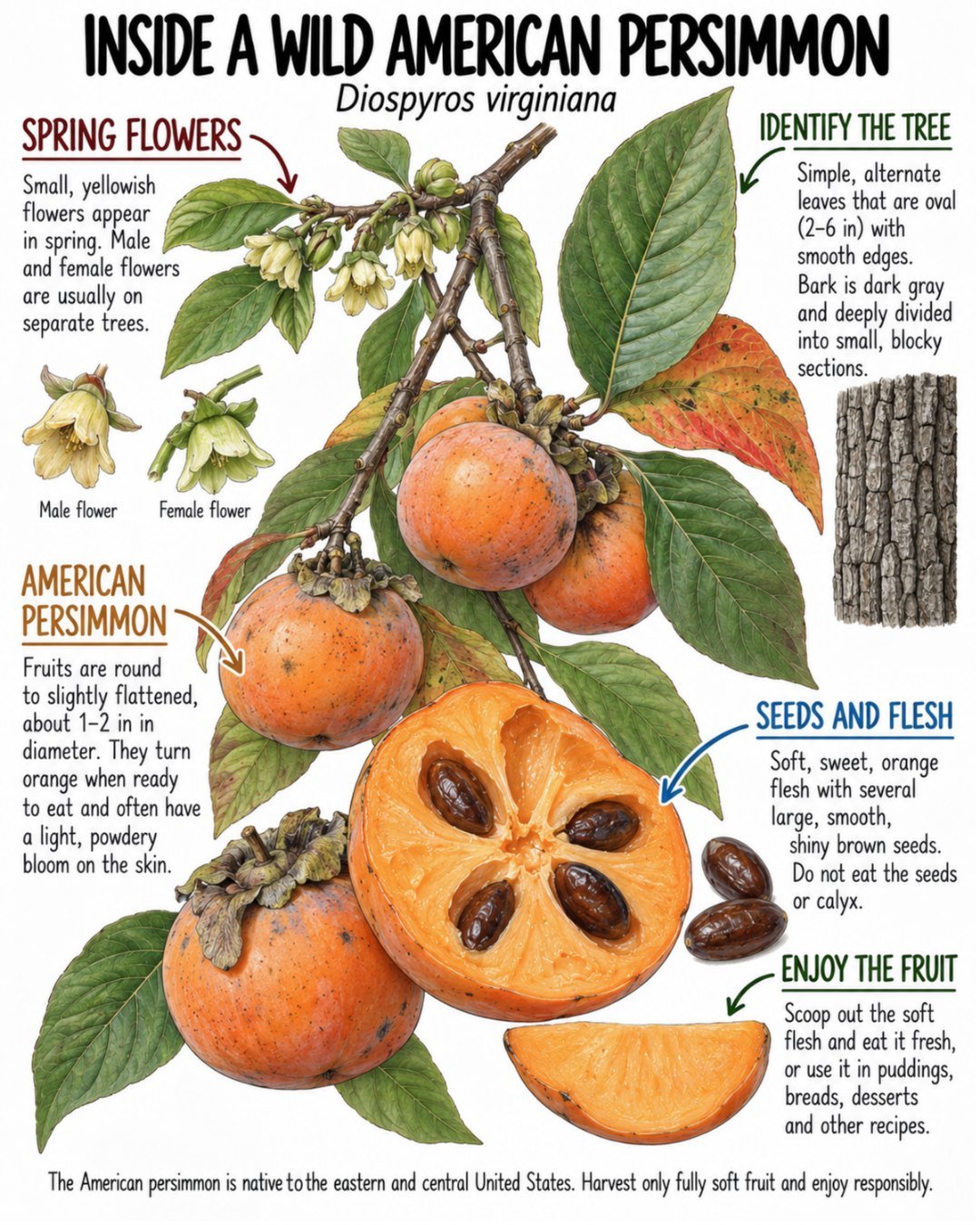
The easiest way to spot a persimmon, even in winter, is the bark. Mature trees have thick, dark gray to almost black bark broken into small square blocks with deep furrows. People often compare it to alligator skin, and once you’ve seen it you won’t forget it.
- Bark: dark gray to black, deeply cut into small, blocky “alligator hide” plates.
- Leaves: simple, alternate, oval, about 2 to 6 inches long, with smooth edges and a glossy top. In fall they can turn yellow, orange, or red.
- Flowers: small, creamy-yellow bells in late spring (May to June). Male and female flowers grow on separate trees.
- Fruit: round to slightly flattened, 1 to 2 inches across, with a stiff four-part cap (the calyx) attached at the top. It turns from green to yellow-orange and finally to a deep, soft orange, sometimes with a purplish tint.
- Where it grows: old pastures, field edges, fence rows, roadsides, and open woods. It likes sun and often forms small thickets by sending up suckers from the roots.
One thing that surprises people: not every persimmon tree makes fruit. The species is dioecious, meaning a tree is either male or female. Only female trees produce persimmons, and they need a male tree somewhere nearby for pollination. If you find a big healthy persimmon with no fruit year after year, you’ve probably found a male.
When is a wild persimmon ripe?
This is where most people get burned, and I’ve been one of them. It’s very normal to think a persimmon is ready when it turns that deep, intense orange. It looks perfect. I’ve bitten into fruit like that, fruit that looked completely ripe, and it was still astringent.
If you’ve never experienced it, the best way I can describe it is a sudden dryness that takes over your whole mouth, like your tongue and gums turned to cotton. That’s tannin. An unripe persimmon is loaded with it, and the feeling sticks around for a few minutes after you spit the fruit out.
Color matters, but it isn’t enough on its own. A ripe persimmon is a combination of the right color and the right texture. Here’s what I look for:
- It falls on its own. Generally the best fruit is the fruit the tree lets go of. I wait for persimmons to drop rather than pulling them off the branch.
- It’s very soft. A ripe wild persimmon feels like a water balloon full of jam. If it’s firm at all, it isn’t ready.
- It’s wrinkled. Ripe fruit often looks shriveled and bruised, almost like it’s starting to go bad. That’s exactly the stage you want.
Do persimmons really need a frost?
Mostly, no. It’s one of the most repeated pieces of persimmon advice, but the frost isn’t what makes the fruit sweet. American persimmons simply take a long time to ripen, and in most areas they finish ripening in late fall, right around the time the first frosts arrive. University of Tennessee Extension explains it the same way: after frost the fruit is sweet because it’s fully mature, not because it was frozen.
That matches what I’ve seen. In some places persimmons start dropping before the first frost, and those early ones can be perfectly good. But generally the biggest harvest comes after the first frost, because that’s when the most fruit reaches full ripeness. Some trees and named varieties ripen early, and some wild trees are just better than others, even when they grow side by side.
How to harvest wild persimmons
My method is simple: let the tree do the work. I wait for the fruit to fall and pick it up off the ground, checking every persimmon before it goes in the bucket:
- No animal bites. Skip anything that has been chewed. You’re sharing this tree with a lot of wildlife.
- No holes. Small perforations usually mean insects or worms got in first.
- No mold or sour smell. Wrinkled is good. Fuzzy, leaking, or fermented is not.
Go often. A productive tree can drop fruit for several weeks, and the animals are out there every night. Deer, raccoons, opossums, squirrels, bears, and many songbirds all eat persimmons. That’s where the name “possumwood” comes from. If you only check once a week, they’ll get most of it.
A practical tip if the tree hangs over grass: lay an old sheet or tarp under it during peak season. The fruit lands clean, and you can collect it in the morning before the animals do.
How to eat American persimmons
A perfectly ripe wild persimmon is sweet, rich, and soft like custard. People describe the flavor as something between dried apricot, dates, and pumpkin, with a little honey. Here’s how I eat them:
Fresh, straight off the ground
This is my favorite way. I squeeze the fruit hard in my hand so the pulp pushes up out of the skin, eat it, and sort the seeds out in my mouth. It’s messy, but it’s fast. And because I’m eating them fresh, I get to check the seeds for the old winter-weather tradition (more on that below).
Persimmon pudding
Persimmon pudding is a classic, especially in Indiana and across the Midwest and South. It’s a dense, moist, spiced dessert, closer to a baked cake than a creamy pudding. It’s also the best answer to a good persimmon year: one tree can suddenly give you far more fruit than you can eat fresh, and pudding uses a lot of pulp at once. The pulp also works in quick breads, cookies, muffins, and anywhere you’d use pumpkin purée.
Making pulp in bulk
Squeezing fruit one at a time is fine for snacking. For baking, rinse the fruit, pull off the caps, and press it through a colander, a sieve, or a food mill. The skins and seeds stay behind and smooth pulp comes through. A food mill is worth it if you plan to process more than a few quarts.
How to store persimmons and persimmon pulp
- Fresh ripe fruit: eat it within a day or two at room temperature. University of Kentucky’s crop profile notes persimmons can be held just above freezing for about two to three weeks.
- Freezing (best option): the National Center for Home Food Preservation recommends making a purée from soft-ripe fruit and freezing it. Adding 1/8 teaspoon of ascorbic acid (vitamin C powder) per quart helps keep the color. Pack the pulp into freezer containers, leaving headspace for expansion.
- Drying: drying also removes astringency, and dried persimmon is a traditional way to keep the harvest.
- Don’t can the purée. There are no tested home canning recommendations for persimmon purée. It’s a dense, low-acid product, so freezing is the safe choice.
The persimmon seed weather tradition
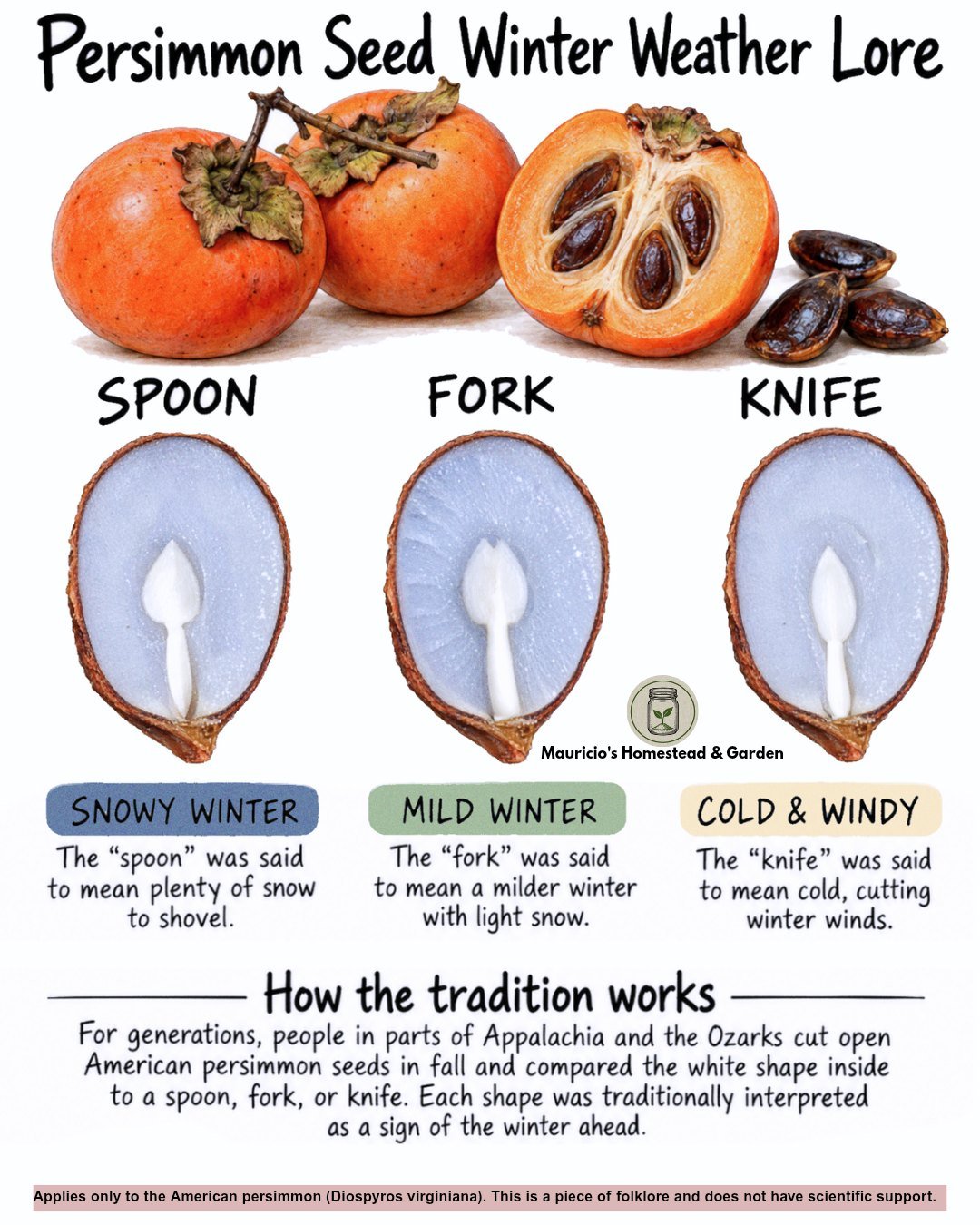
One of the best parts of eating persimmons fresh is checking the seeds. In the Ozarks, Appalachia, and much of the rural South, people have long split persimmon seeds in the fall to “read” the coming winter. Here’s how:
- Take seeds from a ripe, locally grown American persimmon and rinse them clean.
- Carefully split a seed lengthwise along its edge. A sharp knife on a cutting board works, but go slowly, because the seeds are slippery and hard.
- Look at the small white shape (the plant embryo) inside.
- Spoon: a snowy winter (a spoon for shoveling).
- Fork: a mild winter with light snow.
- Knife: a cold, icy winter with “cutting” winds.
Does it work? Not scientifically. Extension specialists explain that the shape comes from the way the embryo and its seed leaves grow inside the seed, not from the weather ahead. Most seeds also show a spoon shape in most years, so a “snowy winter” call comes up far more often than the other two. Enjoy it as a fall tradition, and check the National Weather Service for the real forecast.
Can you grow your own American persimmon?
Yes, and it’s one of the toughest, lowest-maintenance fruit trees you can plant. It’s cold hardy to roughly USDA zones 4 to 9, tolerates poor soil, and has few serious pest problems. A few things to know before you plant:
- Be patient. Trees grown from seed typically start bearing in about 4 to 9 years. Grafted trees can fruit in about 3.
- Plan for male and female. Seedlings can turn out male or female, and you won’t know until they flower. A grafted, named female variety takes the guesswork out, and some varieties can set fruit without a male tree.
- Give it room and sun. Wild trees commonly reach 35 to 60 feet, though they grow slowly. Persimmons have a deep taproot, so they’re best planted young and left in place.
- Expect suckers. Persimmons spread from their roots and can form a thicket if you let them. Mow or clip suckers if you want a single tree.
Safety tips for foraging persimmons
- Only eat fully ripe fruit. Besides tasting terrible, unripe persimmons are high in tannins. Doctors have documented rare cases of hard masses forming in the stomach (called diospyrobezoars) after people ate large amounts of persimmons, especially unripe ones. A few soft, ripe fruits are not a concern for healthy people. Eating a pile of unripe ones is a bad idea.
- Skip the seeds and the cap. Spit out the seeds and discard the calyx.
- Be 100% sure of your ID. Never eat a wild fruit unless you’re certain what it is. Use the bark, leaves, cap, and seeds together, and check with your state extension office or a local foraging group if you’re unsure.
- Respect the land. Ask permission before foraging on private property, and check the rules for public land in your state.
American persimmon FAQ
Why does a persimmon make my mouth feel dry?
That’s astringency from tannins in fruit that isn’t fully ripe. The dry, cottony feeling goes away after a few minutes. Next time, wait until the fruit is very soft and wrinkled, ideally after it falls on its own.
Can I ripen persimmons after picking them?
Fruit that is fully colored and close to ripe will often keep softening indoors over several days. Hard, pale fruit usually won’t turn good. Freezing and drying can also reduce astringency, but nothing beats fruit that ripened fully on the tree.
When is persimmon season?
In most of the persimmon’s range, fruit ripens from September through November, with the heaviest drop usually after the first frost. Some trees hold fruit into early winter.
Are American persimmons the same as the ones in the store?
No. Store persimmons are Asian persimmons, which are much larger and, in some varieties, can be eaten firm. Wild American persimmons are smaller, sweeter when truly ripe, and almost never sold in stores because they’re so soft.
If you’re out gathering wild fruit this fall, you might also like my guide to foraging. And if you’re cutting persimmon wood, it’s one of the hardest woods in North America, so check out my firewood BTU chart.
Sources
- USDA NRCS Plant Guide: Common Persimmon
- University of Kentucky Center for Crop Diversification: American Persimmon
- University of Tennessee Extension: Persimmon
- UF/IFAS Extension: Diospyros virginiana, Common Persimmon
- University of Missouri: Persimmon, Nature’s Fall Fruit
- National Center for Home Food Preservation: Freezing Persimmons
- NC State Climate Office: Persimmon seed folklore
- University of Illinois Extension: Do plants predict weather?
- World Journal of Gastrointestinal Endoscopy: Persimmon phytobezoars (review)
This article is for general educational purposes. Never eat any wild plant unless you are certain of its identification. If you have digestive conditions or have had stomach surgery, talk to your doctor before eating persimmons in quantity.
