Best Firewood for Heat: BTU Chart for 12 Common Species

I’ve burned firewood in almost every kind of climate: in countries with real winters, where a woodpile is what gets a family through the cold months, and in tropical countries, where wood is still one of the cheapest and most available sources of energy compared to gas, gasoline, or electricity. Along the way I’ve burned oak, hickory, maple, ash, and plenty of other species in outdoor fire pits, fireplaces, and cooking fires.
If you ask me which firewood is best, my honest answer is hickory and maple. They have a great balance between weight, volume, and the heat you get out of them, they leave good coals, and they burn for a long time. But “best” also depends on what you can get, how long you can season it, and what you’re burning it in. This guide puts the numbers next to real-world experience so you can choose the right wood for your stove, fireplace, or fire pit.
Quick answer: For heating, the best common firewoods are dense hardwoods like white oak, hickory, beech, sugar maple, red oak, and white ash, which produce roughly 24 to 29 million BTU per cord when seasoned. Light softwoods like eastern white pine give about half as much heat per cord, but they light easily and are great for kindling and mild days. Whatever species you burn, it must be seasoned to about 20 percent moisture or less.
What makes good firewood?
When people compare firewood, they usually talk about BTUs (British thermal units), a measure of heat. But several things together decide whether a wood is “good”:
- Density. Heavier, denser wood packs more fuel into the same cord, so it produces more heat and burns longer.
- Moisture. Even the best species burns poorly if it’s wet. Seasoning matters as much as species.
- Coals. Good coal-producing woods keep a stove warm for hours and make reloading easy.
- Smoke and sparks. Some woods pop and throw sparks, which matters in an open fireplace.
- Ease of splitting. Straight-grained wood splits cleanly; knotty or twisted wood can wear you out.
- Availability and price. The best firewood is often the good hardwood that grows near you.
Firewood BTU chart: 12 common species
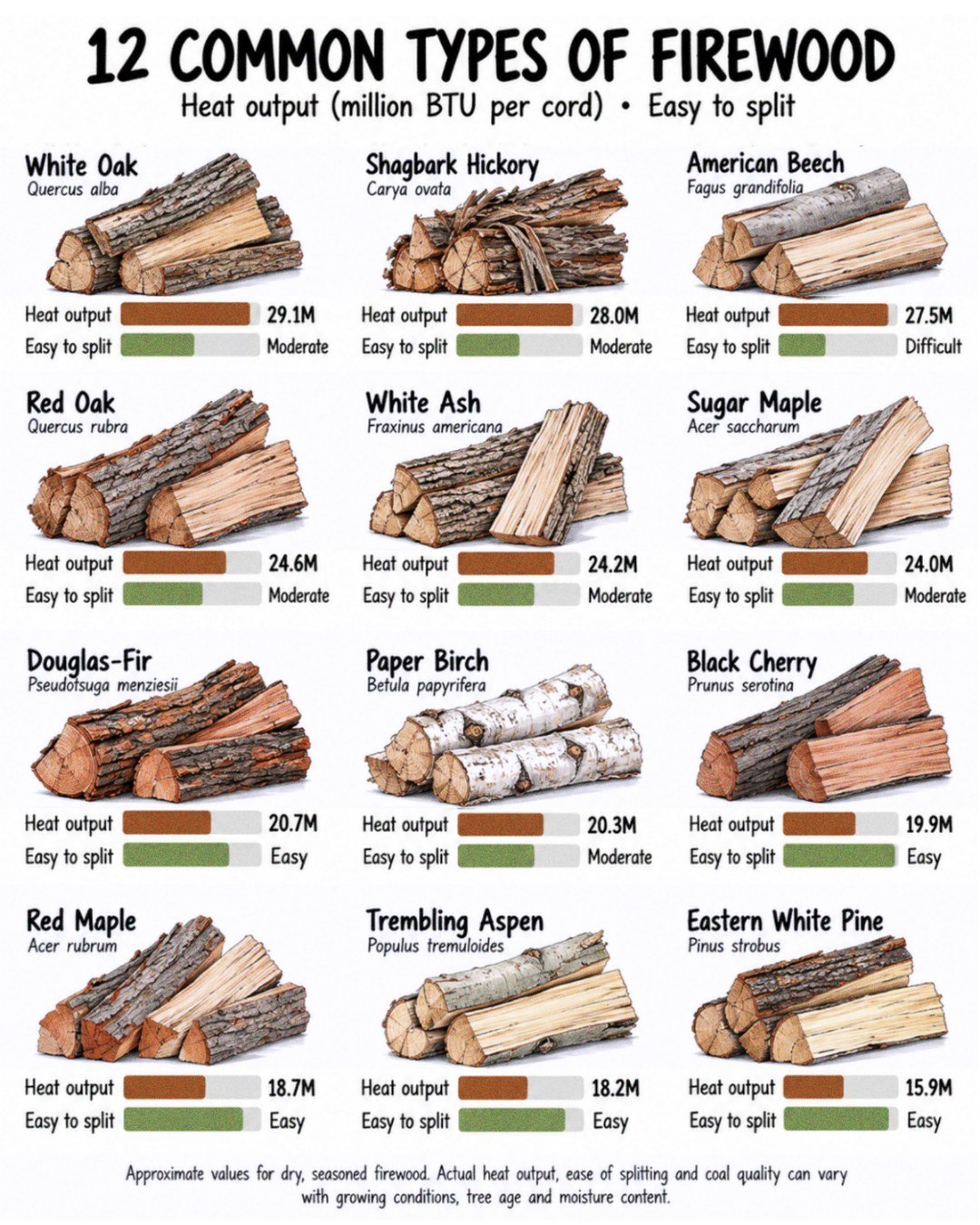
Here are the approximate values for seasoned firewood, from the chart above. These numbers line up with the firewood table published by Utah State University Extension.
| Species | Type | Heat (million BTU per cord) | Splitting |
|---|---|---|---|
| White oak | Hardwood | 29.1 | Moderate |
| Shagbark hickory | Hardwood | 28.0 | Moderate |
| American beech | Hardwood | 27.5 | Difficult |
| Red oak | Hardwood | 24.6 | Moderate |
| White ash | Hardwood | 24.2 | Moderate |
| Sugar maple | Hardwood | 24.0 | Moderate |
| Douglas-fir | Softwood | 20.7 | Easy |
| Paper birch | Hardwood | 20.3 | Moderate |
| Black cherry | Hardwood | 19.9 | Easy |
| Red maple | Hardwood | 18.7 | Easy |
| Trembling (quaking) aspen | Hardwood | 18.2 | Easy |
| Eastern white pine | Softwood | 15.9 | Easy |
A note on the numbers: different sources list slightly different BTU values for the same species, because they use different wood samples, moisture levels, and assumptions about how much wood is in a cord. Use the chart to compare species against each other, not as an exact measurement.
Why heavier wood gives more heat
Pound for pound, most dry wood contains a similar amount of energy. The big difference between species is how many pounds of wood fit in a cord. A cord of dense white oak or hickory simply holds much more wood fiber than a cord of light pine or aspen, so it delivers far more heat for the same stacking space and the same work.
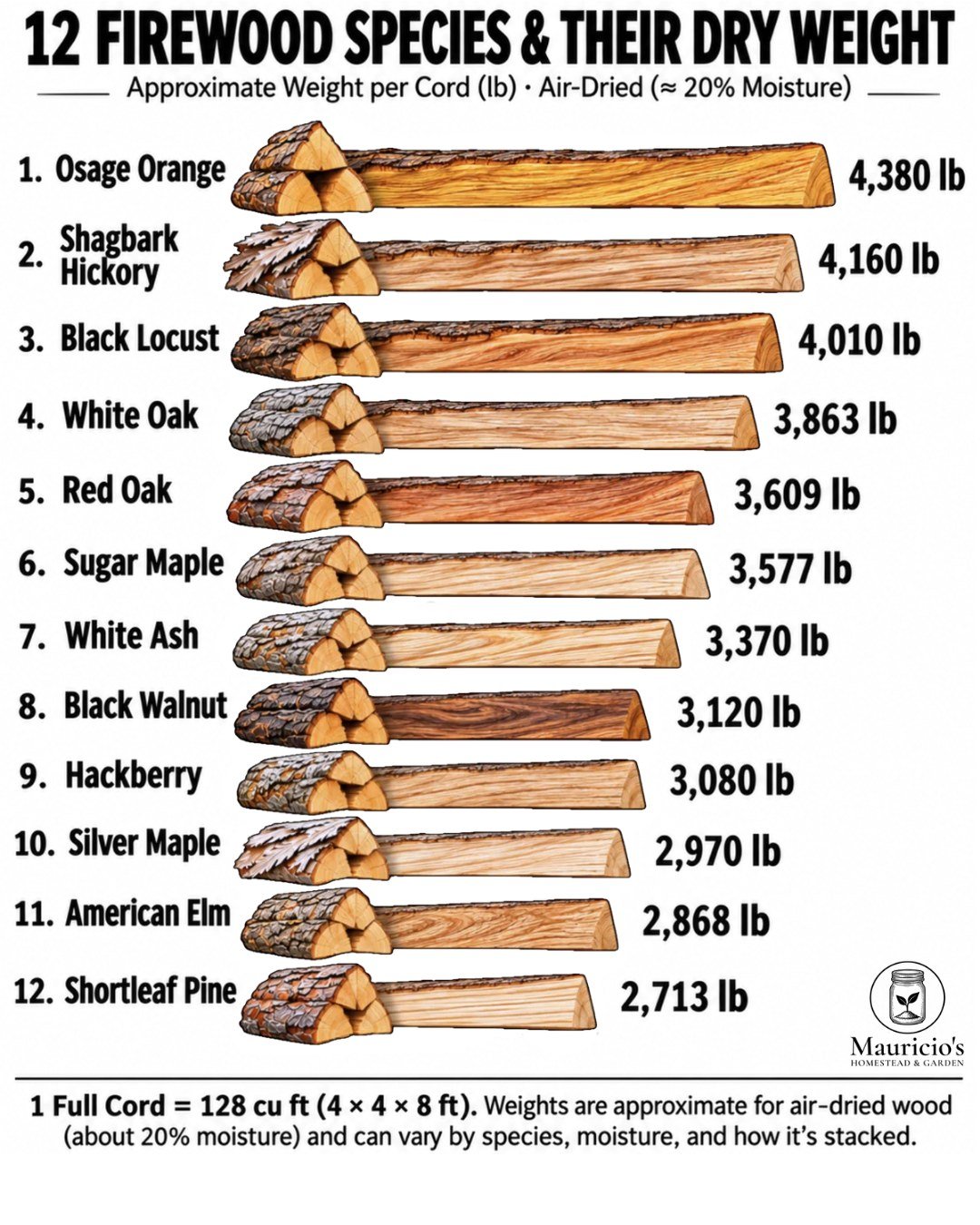
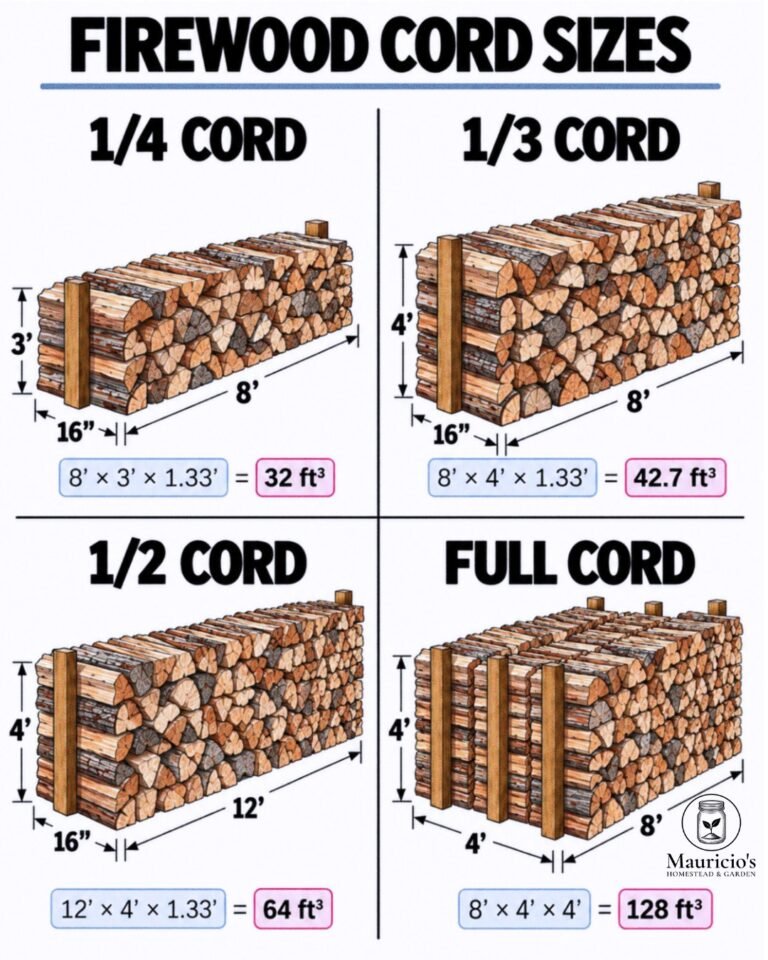
That’s also why buying the right species matters. If two sellers charge the same price per cord, the one selling oak or hickory is giving you much more heat than the one selling pine or aspen. Not sure how much wood you’re actually getting? Read my guide on how much is a cord of wood.
The best firewood species, one by one
Hickory
Hickory is my favorite firewood. It’s heavy, it burns hot and long, and it leaves a deep bed of coals that keeps a stove or fireplace going for hours. It’s also a classic wood for smoking meat. The downside is that it’s heavy to haul and can take time to season.
Oak (white and red)
Oak is the standard against which most firewood is judged. White oak is among the highest-heat common woods, and red oak isn’t far behind. Both make excellent coals, but oak is dense and slow to dry, so plan on a full year of seasoning or more before burning it.
Maple (sugar and red)
Maple is my other favorite. Sugar maple (hard maple) gives heat and coals close to red oak, while red maple (soft maple) is noticeably lighter but still a solid, easy-to-split firewood. If someone offers you “maple,” ask which kind.
American beech
Beech burns hot and long, close to the oaks, but it can be difficult to split. It’s worth the effort if you have it.
Ash
Ash is one of the easiest good hardwoods to split and burns cleanly. Across much of the US and Canada, the emerald ash borer has killed huge numbers of ash trees, so dead ash is often easy to find. Because of that pest, buy or cut ash locally and don’t move it long distances.
Birch
Paper birch lights easily, and its bark is a natural fire starter. It gives medium heat. Split birch and stack it soon after cutting, because the bark holds moisture and the wood can rot if it sits in round logs.
Cherry and other fruitwoods
Black cherry gives moderate heat, splits easily, and smells wonderful when it burns. I’ve used cherry and apple wood to smoke meat and they’re among my favorites for cooking. Fruitwoods are great for the grill, the smoker, or a fire pit where you want flavor and aroma more than maximum heat.
Douglas-fir
Douglas-fir is one of the best softwoods for heat and is very common in the western US. It splits easily and dries faster than most hardwoods.
Aspen and white pine
Aspen and eastern white pine are the lightest woods on the chart. They burn fast and give less heat per cord, which makes them better for kindling, starting fires, and mild fall or spring days than for long, cold nights.
Is it safe to burn pine?
Pine has a bad reputation, and I understand why. In my experience, even dry pine produces a lot of smoke in an open fire and burns too fast. And it’s not always easy to split: many pines are full of knots, so splitting them with an axe can be harder than you’d expect, even though charts often rate pine as easy to split.
But the old belief that pine “clogs your chimney” isn’t really true. When I’ve burned green pine, it dirtied the chimney; dry pine hasn’t caused me any real problems. That matches what wood experts say. According to University of Georgia Extension, the resins in pine don’t cause more creosote than hardwood; burning any seasoned wood in full, hot fires helps avoid creosote buildup, while wet wood and slow, smoldering fires make it worse.
Whatever you burn, have your chimney inspected and cleaned regularly. Creosote can build up from any species if the wood is wet or the fire is kept too low.
Hardwood vs. softwood: should you mix them?
I don’t follow a strict rule here. It mostly depends on what’s available. Many people use softwood or small, dry pieces to get a fire going quickly and to take the chill off on mild days, then switch to dense hardwood for steady heat and overnight coals. Mixing them is perfectly fine as long as everything is properly seasoned.
How long does firewood need to season?
Freshly cut wood is full of water, and burning it wastes heat, makes more smoke, and leads to creosote. Firewood is considered seasoned when its moisture content is below about 20 percent, as University of Tennessee Extension and others recommend.
- In climates with real seasons, I usually let firewood dry for about a year. Dense hardwoods like oak often need that long or longer, while lighter woods dry faster.
- In tropical climates, I’ve found that many species are dry enough in three to four months, because of the constant warmth.
- Species and timing matter. How long it takes also depends on the type of wood and the time of year it was cut.
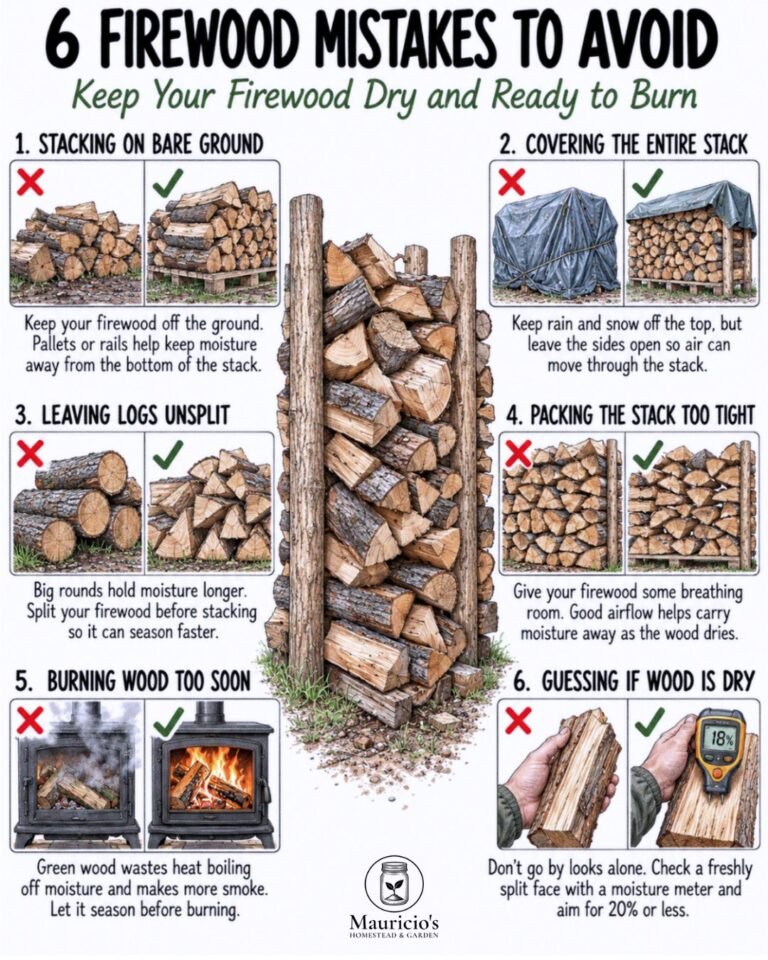
Sun or shade? Many guides recommend stacking firewood where sun and wind can reach it. In my own experience, wood dries very well in the shade as long as it has plenty of airflow and stays out of the rain, drying naturally and evenly. Whichever spot you choose, the key is airflow: split the wood, stack it off the ground, keep rain off the top, and leave the sides open.
The most reliable test is a simple moisture meter. Split a piece and measure the freshly split face, not the outside. If it reads 20 percent or less, it’s ready. For a full walkthrough, see how to season firewood.
What firewood should you never burn?
- Treated, painted, or stained wood, including plywood and construction scraps. Penn State Extension warns they can release dangerous fumes.
- Poison ivy, poison oak, and poison sumac vines. The smoke can cause serious reactions.
- Pallets and old furniture, unless you are certain they are untreated. The UK government’s firewood guidance lists them as treated waste wood not to burn.
- Household trash, cardboard, and glossy paper.
- Green, freshly cut wood in an indoor stove or fireplace.
Frequently asked questions
What firewood burns the hottest?
Among common firewoods, white oak and hickory are at the top. Osage orange (hedge) produces even more heat, but it’s only common in certain regions and can throw a lot of sparks, so it’s best in a closed stove.
Is hickory or oak better firewood?
Both are excellent. White oak has a slight edge in heat per cord in many tables, while hickory is famous for its coals and is my personal favorite. You can’t go wrong with either if it’s well seasoned.
What is the worst firewood?
For heating, the light woods give the least heat per cord: eastern white pine, aspen, cottonwood, and similar species. They aren’t dangerous when dry, they just burn fast. The truly “bad” firewood is wet wood and treated or painted wood.
What is the best wood for a fire pit?
Any dry hardwood works well. Oak and hickory burn long, while cherry and apple add a pleasant aroma. In an open fire pit, avoid woods known for popping and sparks if you’re sitting close.
How can I tell if firewood is seasoned without a meter?
Seasoned wood is lighter than fresh wood, has cracks on the ends, often has loose bark, and makes a hollow sound when two pieces are knocked together. A moisture meter is still the most reliable test.
The bottom line
For heat, choose dense hardwoods like oak, hickory, beech, maple, and ash. Use lighter woods like pine, aspen, and birch to start fires and for mild days. Most important of all, burn only well-seasoned wood. A great species burned wet will always disappoint you, while an average species burned dry will keep you warm.
Have a favorite firewood or a question about what grows near you? Send me a message on the Contact page, and find more guides in the Firewood section.
Sources
- Utah State University Extension: Wood Heating (Firewood Facts table)
- University of Georgia: Weight Best Sign of Seasoned Firewood, Expert Says
- University of Tennessee Extension: Moisture Content of Seasoned Firewood
- Penn State Extension: Heating with Wood, an Introduction
- UK Department for Environment, Food & Rural Affairs: Seasoning Wood
This article is for general education. Always follow your stove or fireplace manufacturer’s instructions and local burning rules. See our Disclaimer.