Hardneck vs. Softneck Garlic: How to Tell Them Apart (and Which to Grow)

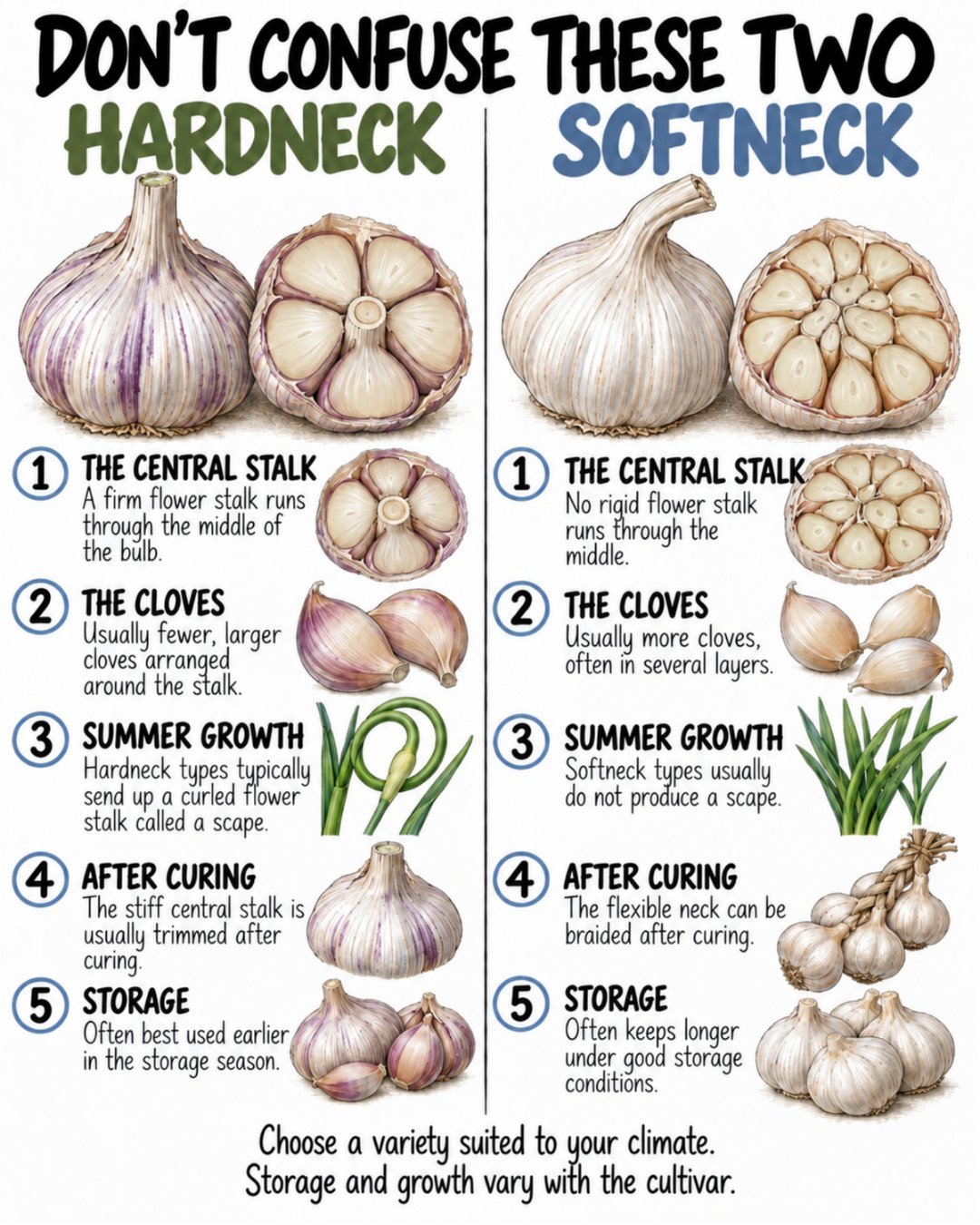
Quick answer: Hardneck garlic grows a stiff central stalk, sends up a curly scape in spring, has fewer but bigger cloves in a single ring, tastes stronger and spicier, and handles cold winters best, but it stores for a shorter time. Softneck garlic has no rigid stalk and usually no scape, packs many cloves in several layers, has a milder flavor, braids easily, and stores the longest. Grow hardneck for flavor and cold winters, softneck for storage, braiding, and milder climates. Many gardeners grow both.
I’ve grown both hardneck and softneck garlic with good results, and I keep certain softneck varieties like a treasure. I never skip planting them. But they really are two different crops, and choosing the right one for your climate and your kitchen makes a big difference. Here’s how to tell them apart and which one to plant.
Hardneck vs. softneck garlic at a glance
| Hardneck | Softneck | |
|---|---|---|
| Botanical name | Allium sativum var. ophioscorodon | Allium sativum var. sativum |
| Center of the bulb | Stiff, woody flower stalk | No rigid stalk |
| Cloves | Fewer, larger, in one ring | Many, in several layers |
| Scapes | Yes, curly and edible | Usually not |
| Flavor | Stronger, spicier, more complex | Milder (varies by variety) |
| Climate | Best in cold winters | Wide range, best in mild winters |
| Braiding | No | Yes |
| Storage | Shorter, often a few months | Longest, often 6 to 12 months |
How to tell them apart
1. Look at the center of the bulb
This is the surest test. Cut a bulb in half or pull the cloves apart. Hardneck garlic has a hard, woody stalk running right through the middle, and the cloves are arranged around it in a single circle. Softneck garlic has no stiff stalk. Instead, its cloves are packed in layers, with big cloves on the outside and smaller ones toward the center.
2. Count the cloves
Hardneck bulbs usually have fewer, larger cloves that are easy to peel. Softneck bulbs often have 12 to 20 cloves or more in multiple layers, including some small inner ones.
3. Watch for scapes in spring
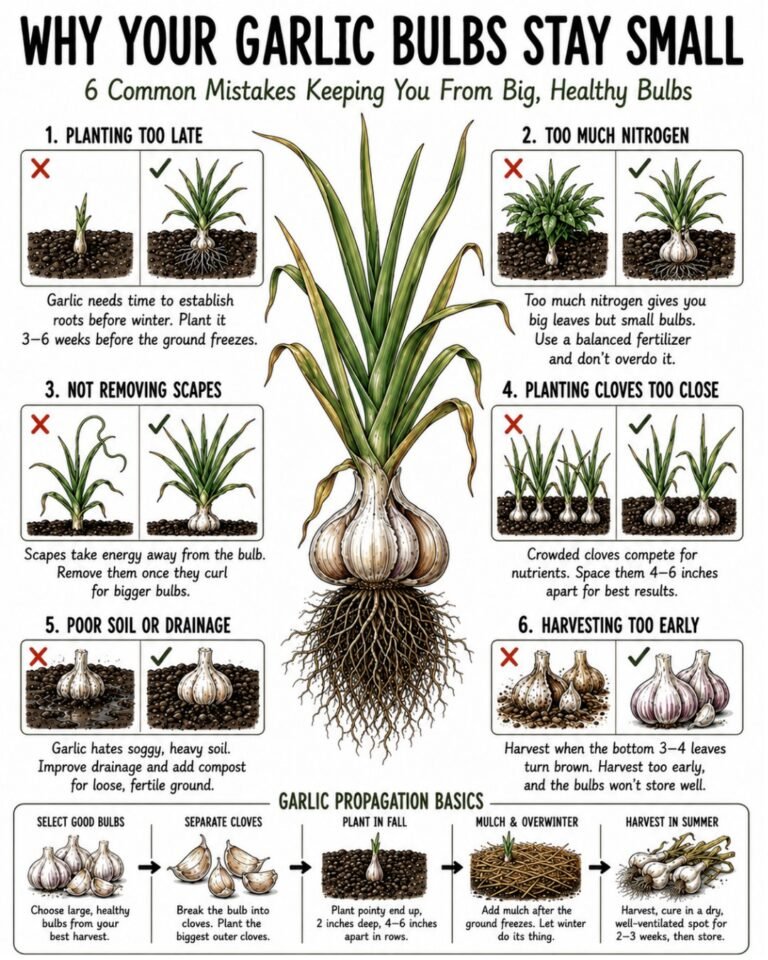
In late spring, hardneck garlic sends up a curling flower stalk called a scape. Softneck garlic generally doesn’t. My own softneck garlic never makes a scape, while my hardnecks always do. With hardnecks, cut the scapes off so the plant puts its energy into the bulb. I explain why in why your garlic bulbs stay small.
4. Feel the neck after curing
A cured hardneck has a stiff neck you have to cut. A cured softneck has a soft, flexible neck that can be braided.
Hardneck garlic: the flavor garlic for cold winters
In my experience, hardneck garlic adapts better to cold winters, and its flavor is more intense and spicier. Even its leaves and scapes are great for seasoning. It’s really more of a garlic to harvest and eat, although it can be stored too. University of Wisconsin–Madison Extension groups hardnecks into three main types:
- Rocambole: rich flavor and easy to peel, but the shortest storage, often only 3 to 4 months.
- Porcelain: few, very large cloves. Stores 4 to 8 months, and the flavor often gets stronger in storage.
- Purple Stripe: colorful cloves and dramatic curly scapes. Stores a little longer than rocamboles.
Best for: gardeners in the northern U.S., Canada, the UK, and other places with real winters, and cooks who want bold garlic flavor plus a spring harvest of scapes.
Softneck garlic: the storage and braiding garlic
Softneck is the garlic I know best. It’s the kind you find in most grocery stores, because it’s productive, adapts to a wide range of climates, and stores for a long time. There are two main types: Artichoke and Silverskin.
Two softneck varieties I never stop planting:
- Inchelium Red: an Artichoke-type softneck found on the Colville Reservation in Inchelium, Washington. It produces big bulbs, and its flavor is milder than most garlic I’ve grown. It’s a great all-around kitchen garlic.
- Nootka Rose: a Silverskin-type softneck heirloom from the San Juan Islands off the Washington coast. Its neck gets especially soft, which makes it perfect for braiding, and it’s known as one of the longest-storing garlics.
Best for: gardeners with mild winters, anyone who wants garlic in the pantry until next year’s harvest, and anyone who wants to braid.
How long does garlic really store?
The usual rule is that softneck garlic keeps about 9 to 12 months. In my experience, it depends on a lot of things, especially curing and where you store it. In a cool, dry place, I’ve had softneck garlic still perfect at 15 months. I’ve also lost garlic at just 3 months. The difference almost always came down to how well it was cured.
My garlic curing table
I cure my garlic on a rustic table I built from recycled pallet boards, with about a one-inch gap between each board. When I harvest, I set the plants in the gaps with the bulbs up and the stems hanging down through the slats. Air moves all around the bulbs, they cure evenly, and the stems don’t dry out so much that they become impossible to braid.
A few curing basics:
- Cure in a shady, dry, well-ventilated place, never in direct sun.
- Give it about 2 to 4 weeks, until the necks are dry and the wrappers are papery.
- Braid softnecks while the stems are still a little flexible.
- Store in a cool, dry, dark place with airflow, not in the refrigerator and not in plastic bags.
Which garlic should you plant?
- Cold winters, and you love strong flavor? Plant hardneck.
- Mild winters, or you want garlic that lasts all year? Plant softneck.
- Not sure? Plant both. Many gardeners use hardneck first for its flavor and scapes, and keep softneck for the long winter months.
Whatever you choose, buy planting garlic suited to your region, and save your best bulbs to replant. For step-by-step planting, see my guide on how to plant garlic in fall.
Hardneck vs. softneck FAQ
Is grocery store garlic hardneck or softneck?
Almost always softneck. It stores and ships well, which is why it dominates commercial production. UMass Extension also notes that grocery store garlic may be treated with a sprout inhibitor, another reason not to plant it.
Can hardneck garlic grow in warm climates?
Some can, but most hardnecks need a cold winter to form good bulbs. In mild-winter areas, softneck varieties are usually more reliable.
Which garlic tastes better?
That’s personal. Hardnecks are usually stronger and spicier. Softnecks are often milder, though some, like Nootka Rose, have plenty of punch. Growing both lets you choose by the dish.