How Much Is a Cord of Wood? Full Cord vs. Face Cord Explained

If you heat with wood, sooner or later someone will offer you “a cord,” “a face cord,” or “a truckload” of firewood, and those can mean very different amounts of wood. I’ve cut, split, stacked, and bought firewood myself, and the same mistakes come up again and again: people don’t know how much wood they’re actually paying for, they buy pieces that don’t fit their stove, and they stack the wood on bare ground or on a flimsy rack that eventually collapses under the weight.
This guide explains exactly how big a cord is, what a face cord really means, which measurements are legal for selling firewood in most of the United States, how to measure a pile yourself, and how to stack your wood so it stays dry and standing.
Quick answer: A full cord of firewood is a tightly stacked pile that measures 128 cubic feet, usually 4 feet high, 4 feet deep, and 8 feet long. A “face cord” (also called a rick) is a single row 4 feet high and 8 feet long, but only as deep as the pieces are long. With standard 16-inch pieces, a face cord is about one-third of a full cord.
What is a cord of wood?
In the US, the cord is the standard unit for selling firewood. A cord is 128 cubic feet of wood that is “ranked and well stowed,” which simply means the pieces are stacked tightly, parallel to each other, with as few gaps as possible. This definition comes from NIST Handbook 130, the model regulation that most states use for weights and measures.
The classic shape is 4 feet high, 4 feet deep, and 8 feet long, but any tightly stacked pile that adds up to 128 cubic feet is a cord. For example, a stack 2 feet high, 4 feet deep, and 16 feet long is also a full cord.
Keep in mind that a cord is not 128 cubic feet of solid wood. There is always air between the pieces. Straight, evenly cut, tightly stacked wood gives you more actual wood per cord than crooked or uneven pieces thrown together.
Firewood cord sizes at a glance
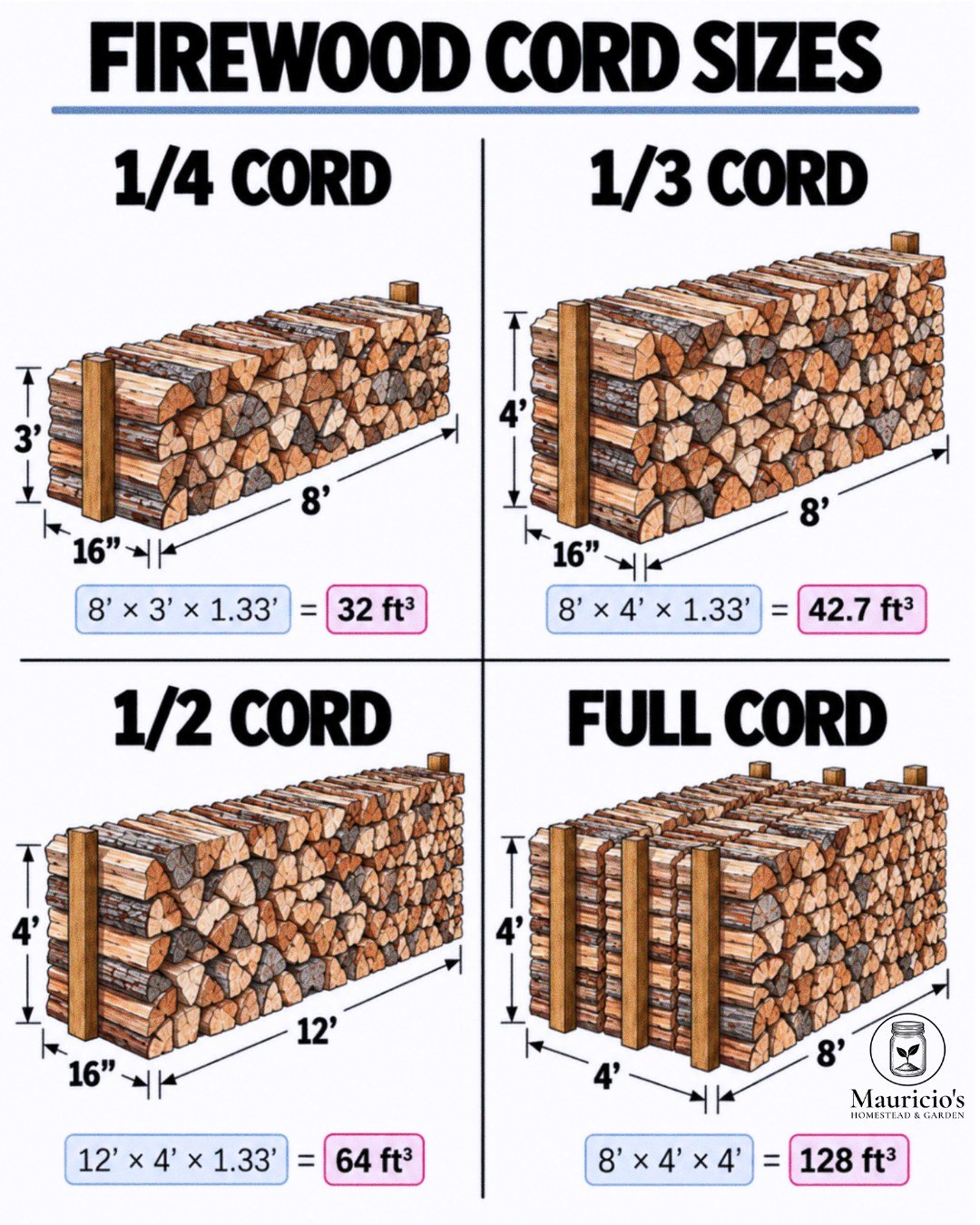
Here are the most common fractions of a cord, using the standard 16-inch piece length:
| Amount | Typical stack (16-inch pieces) | Volume |
|---|---|---|
| Full cord | 8 ft long × 4 ft high × 4 ft deep (three rows) | 128 cu ft |
| 1/2 cord | 12 ft long × 4 ft high × 16 in deep | 64 cu ft |
| 1/3 cord (often called a “face cord”) | 8 ft long × 4 ft high × 16 in deep | 42.7 cu ft |
| 1/4 cord | 8 ft long × 3 ft high × 16 in deep | 32 cu ft |
| 1/8 cord | 4 ft long × 3 ft high × 16 in deep | 16 cu ft |
The shape doesn’t matter as much as the total volume. A half cord can also be a stack 4 feet high, 4 feet deep, and 4 feet long. What matters is that the numbers multiply to the right number of cubic feet.
What is a face cord (or rick)?
A face cord, also called a rick, rank, or stove cord depending on the region, is a single row of firewood 4 feet high and 8 feet long. The problem is the third dimension: its depth is simply whatever length the pieces were cut to. That means the same “face cord” can hold very different amounts of wood:
| Piece length | Face cord volume | Share of a full cord |
|---|---|---|
| 12 inches | 32 cu ft | 1/4 cord |
| 16 inches | 42.7 cu ft | 1/3 cord |
| 24 inches | 64 cu ft | 1/2 cord |
So if two sellers both offer “a face cord for $120,” one of them may be giving you twice as much wood as the other. Always ask how long the pieces are.
Is it legal to sell firewood by the face cord?
In states that follow NIST Handbook 130, firewood must be sold by the cord or by a fraction of a cord, and the terms “face cord,” “rack,” “pile,” “truckload,” and similar terms are not allowed when advertising or selling firewood. Connecticut and Arizona, for example, both spell this out in their firewood rules. Sellers can still describe a stack as “1/3 cord” or “42.7 cubic feet.”
Rules vary from state to state, and in some regions you’ll still see “face cord” in local ads. If you’re not sure what applies where you live, check with your state’s weights and measures office (usually part of the Department of Agriculture). Many states also require the seller to give you a receipt. In Maryland, for example, the invoice must show the seller’s name and address, the buyer’s name, the delivery date, the amount of wood, and the price.
What this means for you: before you agree on a price, ask two questions: “What fraction of a cord is this, in cubic feet?” and “How long are the pieces?”
How to measure a pile of firewood
You don’t need special tools, just a tape measure and a calculator.
- Stack the wood tightly. Lay the pieces parallel in neat rows, touching each other, with as few gaps as possible.
- Measure the length, height, and depth in feet. The depth of a single row is the length of the pieces. Measure the height in a few places and use the average, because stacks are rarely perfectly level.
- Multiply length × height × depth to get cubic feet.
- Divide by 128 to get the number of cords.
Example: a single row that is 10 feet long and 4.5 feet high, made of 16-inch (1.33-foot) pieces: 10 × 4.5 × 1.33 = about 60 cubic feet. 60 ÷ 128 = 0.47, just under half a cord.
Tip: if you measure in inches, multiply the three numbers and divide by 1,728 to get cubic feet.
Loose (thrown) wood vs. stacked wood
Wood that’s dumped from a truck takes up a lot more space than the same wood stacked neatly. Montana State University Extension notes that a loose cord can take up about 30 percent more space than a stacked one. That’s why a big pile in your driveway often shrinks into a surprisingly small stack. The University of Missouri Extension recommends that buyer and seller measure the tightly stacked wood together, for example on the truck bed, before the sale is completed.
If you think you received less than you paid for, contact the seller before you burn any of the wood, and take photos and measurements. If you can’t resolve it, your state’s weights and measures office can help.
Match the firewood to your stove before you buy
This is the mistake I see most often. People buy a cord of wood and then discover the pieces don’t fit in their stove or fireplace, so they end up re-cutting part of the load by hand.
- Measure the inside of your firebox in the direction you load the wood (front to back or side to side).
- Choose pieces 2 to 3 inches shorter than that measurement so they slide in easily and leave room for coals. Your stove manual often lists the maximum log length.
- 16 inches is the most common length sold in the US and fits most standard stoves, but small stoves may need 12 to 14 inches, and large fireboxes or outdoor boilers can take 20 inches or more.
- Ask for consistent splits, roughly 3 to 6 inches across. Pieces that are too big are hard to light and slow to dry; pieces that are too small burn up fast.
Remember that piece length also changes how much wood you get in a “face cord,” so knowing your stove size helps you compare prices too.
How to stack firewood so it stays dry (and standing)
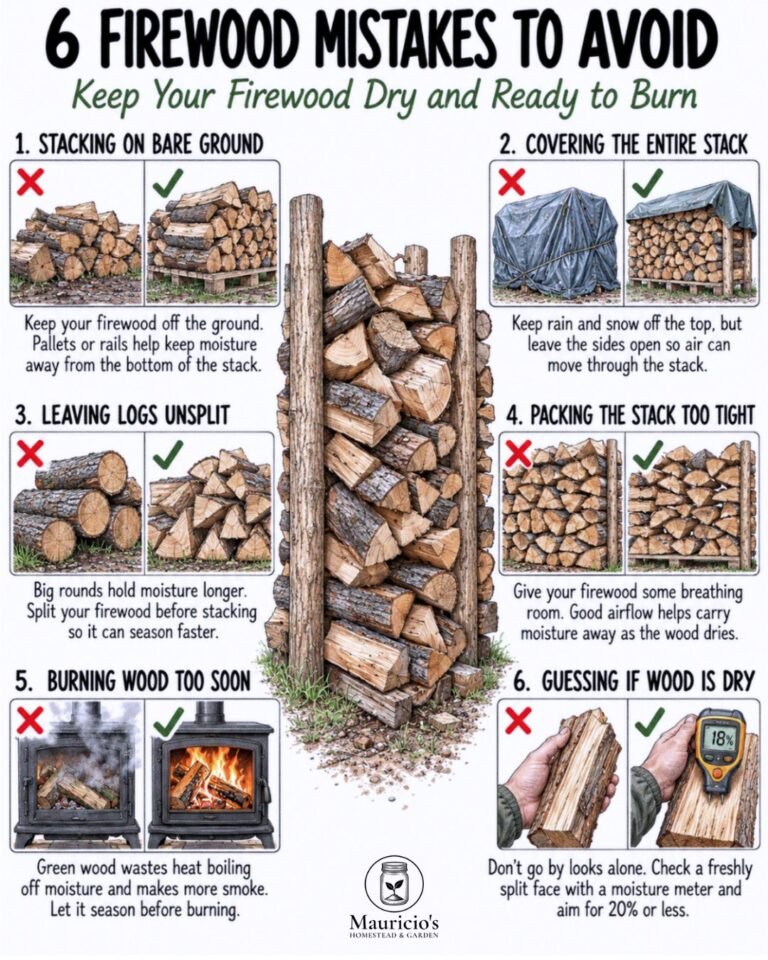
Over the years I’ve seen plenty of stacks rot from the bottom up or slowly lean and collapse. Most of the time it comes down to two things: the wood was sitting on the ground, or the support wasn’t strong enough for the weight.
1. Get it off the ground
Wood stacked directly on soil soaks up moisture from below, rots, and attracts insects. University of Illinois Extension recommends stacking firewood off the ground so air can circulate. Pallets, two rails of treated lumber, concrete blocks, or a sturdy metal rack all work.
2. Respect the weight
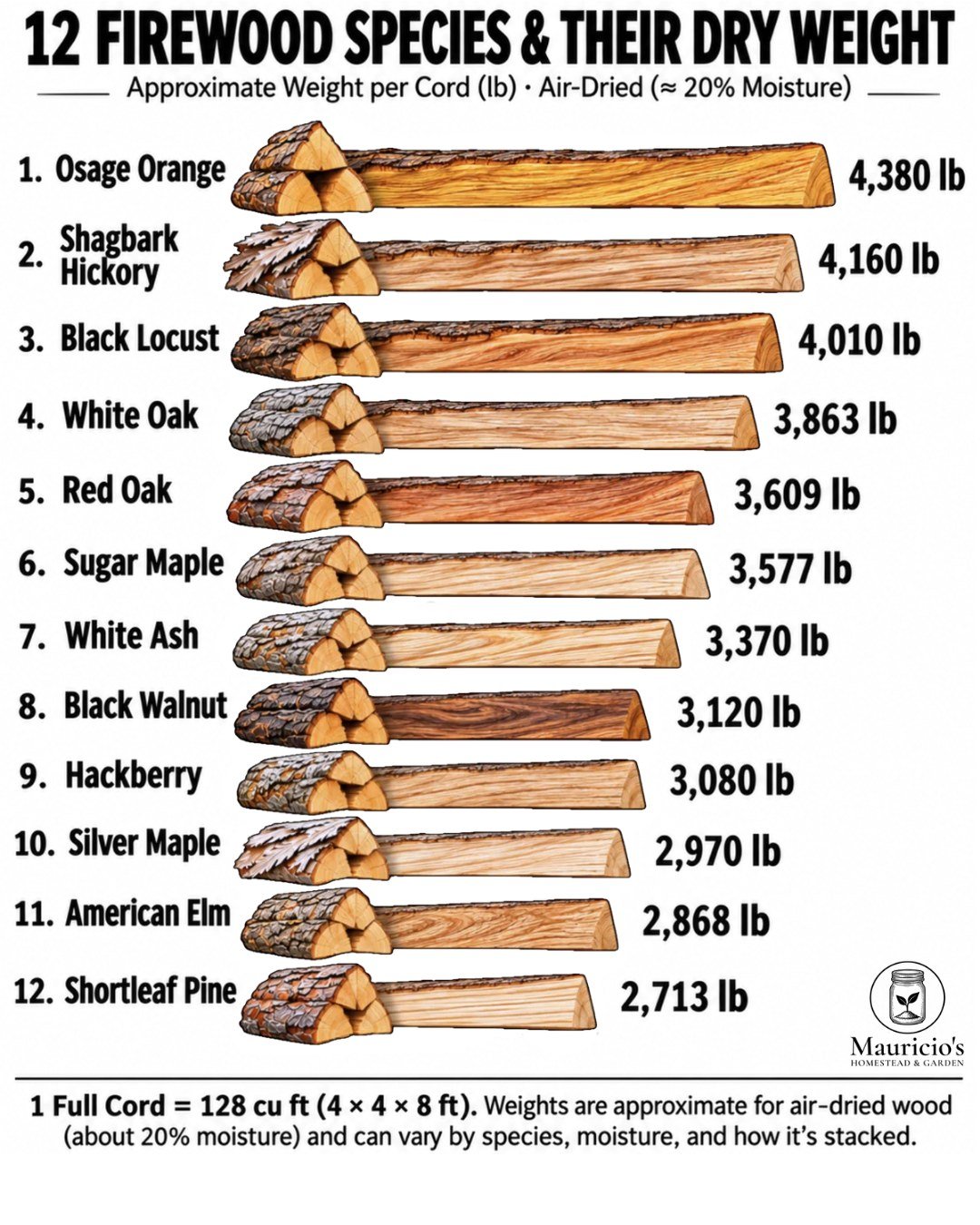
Firewood is much heavier than most people expect. Even air-dried, a full cord of common firewood species can weigh roughly 2,700 to 4,400 pounds depending on the species, so even a half cord can easily top a ton. Thin decorative racks, a few nails in a fence, or a stack leaning against a shed wall often can’t handle that load for a whole season.
3. Build strong ends
The ends of a stack carry most of the side pressure. Either use solid end supports (posts set firmly in the ground or a well-built rack), or build each end as a crisscross “log cabin” column, alternating the direction of each layer. Keep the rows straight and don’t stack too high for the base you have.
4. Cover the top, not the sides
Put a cover, tarp, or roof over the top of the stack to keep rain and snow off, but leave the sides open. Sun and wind are what dry the wood. A single row in a sunny, breezy spot dries much faster than one big block.
5. Keep the main stack away from your house
Stacking a whole season of wood against your house invites insects and rodents and adds fuel near your walls. Keep the main stack a few feet away and bring a small supply closer as you need it.
Firewood buying checklist
- Ask for the price per full cord and exactly what fraction (in cubic feet) you’re getting.
- Ask the piece length and split size, and make sure they fit your stove.
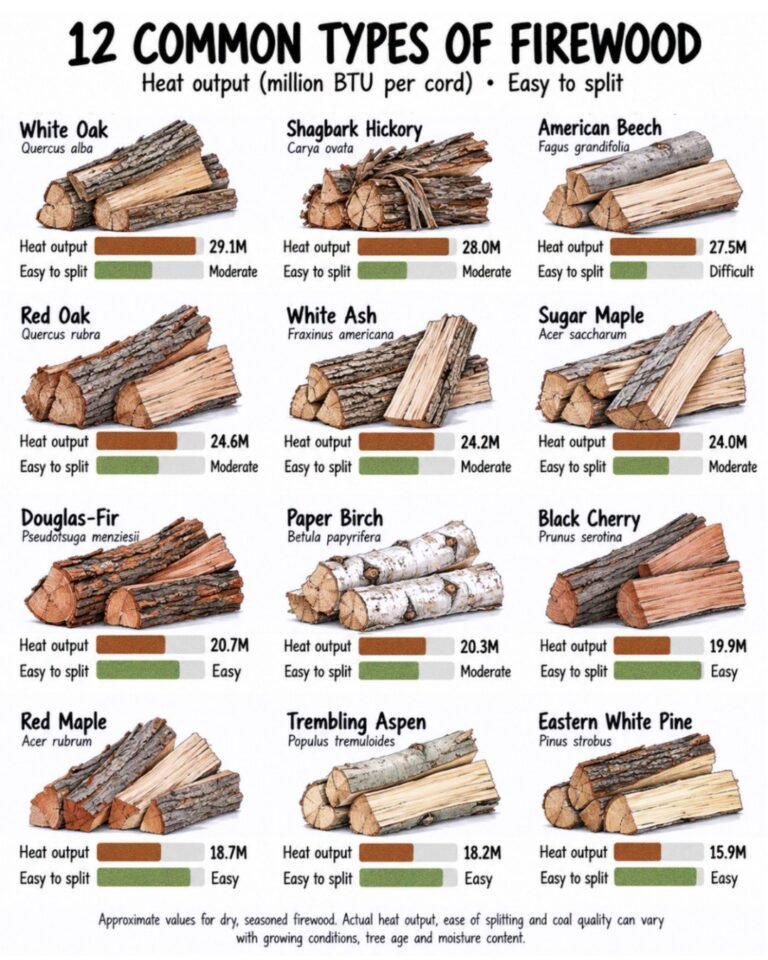
- Ask what species it is. Dense hardwoods like oak, hickory, and locust give more heat per cord than light woods (see my firewood BTU chart).
- Ask whether it’s seasoned and for how long. Properly seasoned wood is usually below about 20 percent moisture.
- Ask whether it will be delivered stacked or dumped loose.
- Get a receipt with the seller’s name, the amount, and the price.
- Stack and measure the wood before you burn it.
- Buy firewood locally. Moving firewood long distances can spread invasive insects and diseases, and many areas restrict it.
Frequently asked questions
How many face cords are in a full cord?
With standard 16-inch pieces, three face cords make one full cord. With 24-inch pieces it takes two, and with 12-inch pieces it takes four.
How much does a cord of firewood weigh?
It depends mostly on the species and how dry the wood is. An air-dried cord of common firewood weighs roughly 2,700 to 4,400 pounds. Green, freshly cut wood is much heavier because it still holds a lot of water.
Is a rick the same as a face cord?
Yes. “Rick,” “face cord,” “rank,” and “stove cord” are regional names for a single row about 4 feet high and 8 feet long. Because the depth depends on the piece length, it isn’t a fixed amount, and in many states it isn’t a legal unit for selling firewood.
What size is a half cord of wood?
A half cord is 64 cubic feet. With 16-inch pieces, that’s a single row about 12 feet long and 4 feet high, or a stack 4 feet high, 4 feet deep, and 4 feet long.
How much firewood fits in a pickup truck?
It varies a lot with the size of the bed and how the wood is loaded. As a rough guide, a full-size pickup with an 8-foot bed holds around half a cord when the wood is stacked tightly up to the top of the bed sides, and a short bed holds noticeably less. Wood that’s thrown in loosely holds even less, which is why “a truckload” isn’t a reliable measure.
The bottom line
A full cord is 128 cubic feet of tightly stacked wood. Everything else, whether it’s called a face cord, a rick, or a truckload, only makes sense once you know the dimensions and the piece length. Measure your firebox before you buy, measure the pile when it arrives, and stack it off the ground on a support strong enough for the weight. Your wallet, your stove, and your back will thank you.
Have a question about buying or stacking firewood? Send me a message through the Contact page, and check out more guides in the Firewood section.
Sources
- Connecticut Department of Consumer Protection: Firewood and Stove Wood Regulations (from NIST Handbook 130)
- Arizona Department of Agriculture: Firewood Sale Requirements
- Maryland Department of Agriculture: Tips for Buying Firewood
- University of Missouri Extension: How to Buy and Sell Firewood
- Montana State University Extension: How Is a Cord of Firewood Measured?
- University of Illinois Extension: How to Measure and Handle Firewood
- Southwest Clean Air Agency: Firewood Tips
Information in this article is for general education. Firewood rules vary by state and locality, so check with your local weights and measures office. Always follow your stove manufacturer’s instructions. See our Disclaimer.